The One Thing Report Cards Never Tell You About Your Child
Your child brings home a report card. The grades look fine, maybe even good. And yet something feels off. Homework is a nightly battle. A subject that clicked last year suddenly doesn’t. Or your child is clearly bright but somehow drifting, bored, or anxious in ways the letter grades don’t explain.
If that gap between “the grades are okay” and “something isn’t right” sounds familiar, you’ve already run into the limit of what a report card can tell you. What you’re actually looking for has a name: student readiness. And it’s the single most useful thing to understand about how your child learns precisely because no report card measures it.
What is student readiness?
Student readiness is your child’s actual preparedness to take on the next stage of learning, not just whether they’ve memorized this year’s material, but whether the underlying skills, confidence, and thinking habits are in place to build on it.
A grade answers a backward-looking question: Did my child perform on the work already assigned? Readiness answers a forward-looking one: Is my child genuinely equipped for what comes next? Those are not the same question, and the difference is where most parents get blindsided.
Think of it like a house. A report card tells you the paint looks good and the furniture is arranged. Student readiness tells you whether the foundation can hold another floor. A child can score well on this year’s tests and still be missing a foundational skill that quietly caps how far they can go next year or carry an unmeasured strength that’s going completely unused.
Why report cards miss it entirely
Report cards were never designed to measure readiness. They’re a summary of output assignments completed, tests passed, behavior noted averaged into a letter. That design creates three blind spots that matter enormously for a parent trying to make good decisions.
They measure performance, not the gaps underneath it. A “B” in math can mean a child who deeply understands most concepts and is stuck on one, or a child who has learned to compensate by memorizing procedures without grasping why they work. Same grade, completely different next step. The report card can’t tell them apart. A readiness view can.
*They ignore how your child learns.* Two children can reach the same grade by entirely different routes: one who learns by seeing, one who learns by doing, one who needs to talk it through. Report cards flatten all of that into a single number. But learning modality is often the real reason a capable child is struggling: the material isn’t too hard, it’s just being delivered in the wrong channel for that child.
They hide the bright kid who’s coasting and the struggling kid who’s compensating. Grades reward turned-in work, so a gifted child who’s bored and under challenged and a child who’s masking a real gap can both land in the comfortable middle of the report card. Neither is being served. Neither shows up as a problem until it’s harder to fix.
This is why “the grades are fine but something’s wrong” is such a common feeling among thoughtful parents. You’re sensing a readiness gap that the reporting system simply isn’t built to show you.
The three dimensions of student readiness
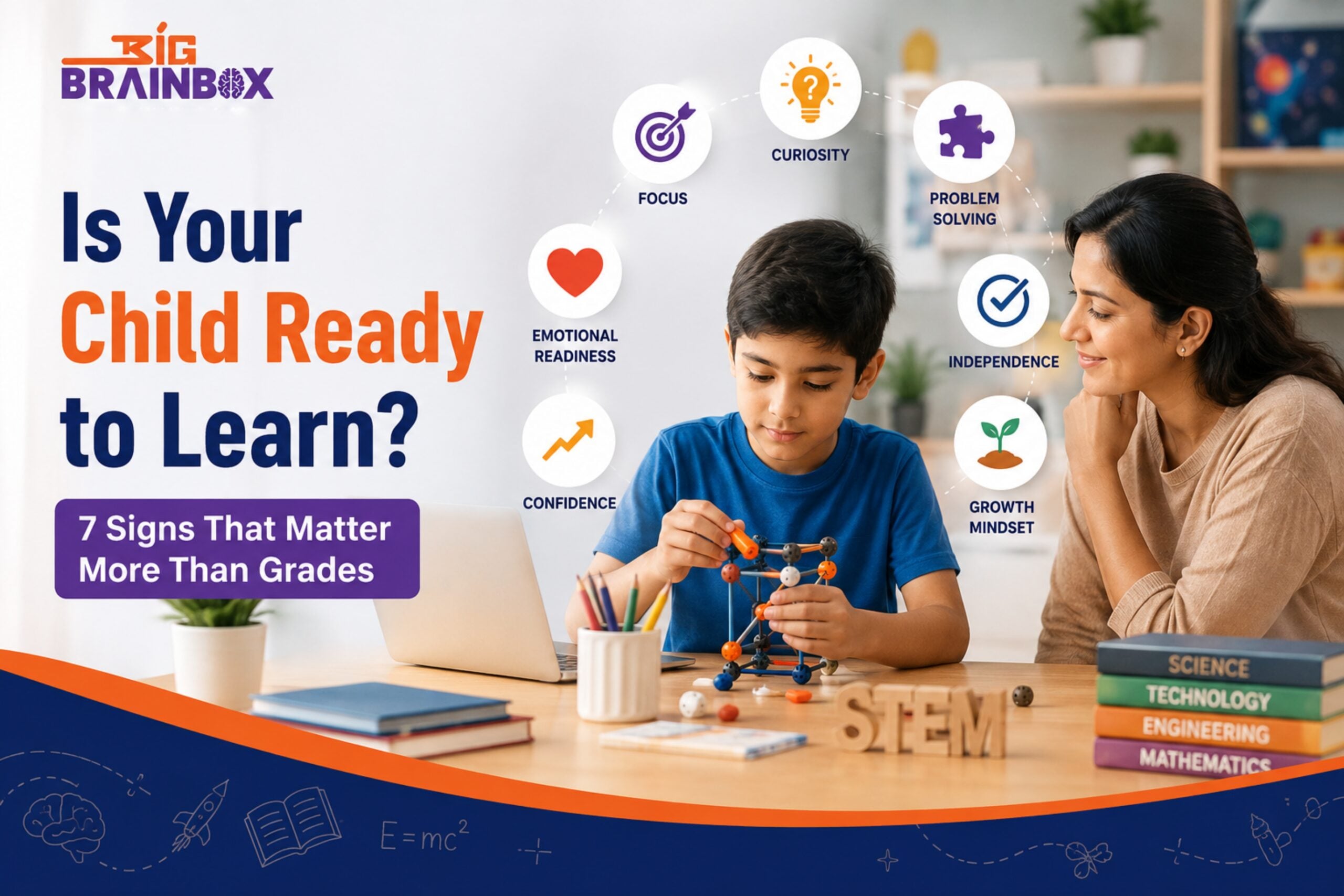
Readiness isn’t a single score, it’s a profile across a few dimensions that work together. When we assess a child at Big Brainbox, we look at readiness across three:
Academic readiness the concrete skill foundations for the next level. Not “did they pass,” but which specific competencies are solid, which are shaky, and which are missing. This is the difference between “needs help with math” and “has algebra-readiness gaps in fractions and proportional reasoning” , a diagnosis specific enough to act on, whether the next step is targeted academic tutoring or an enrichment pathway.
Cognitive and learning-style readiness how your child actually takes in and processes information: visual, verbal, or kinesthetic. Understanding this turns a frustrating subject into an approachable one, because you finally match the teaching to the learner instead of the other way around.
Confidence and self-efficacy whether your child believes they can tackle hard things. This is the quiet multiplier. A child with real skills but no confidence shuts down at the first difficulty; a child with confidence keeps going long enough to actually build the skill. It rarely shows up in a grade, but it shapes everything.
For neurodivergent learners children with ADHD, ASD, dyslexia, or a twice-exceptional profile these dimensions matter even more, because standard reporting is even more likely to misread them. A child with ADHD may have strong reasoning and a genuine executive-function gap sitting side by side; the report card averages them into something that describes neither. That’s why Big Brainbox’s Neuro Academy provides a dedicated assessment pathway for these learners, not a standard process with adjustments bolted on.
How to actually measure student readiness
You can start to read your child’s readiness at home by watching for signals the report card doesn’t capture. Does your child resist a subject they used to enjoy? Can they explain why an answer is right, or only produce the answer? Do they light up when a concept is shown a certain way and stall when it’s shown another? Do they give up quickly on hard problems, regardless of ability? Those patterns tell you more about readiness than any grade.
But observation only goes so far. To turn a hunch into something you can act on, you need a structured assessment one that measures the foundations directly rather than inferring them from output.
That’s exactly what the Big Brainbox Competence Assessment is built to do. It’s a 45 to 90 minute, no-pressure session with no grades, no right-or-wrong-answers, no test anxiety where a specialist instructor works with your child across visual, verbal, and kinesthetic dimensions to map where they actually stand. Within 48 hours, you receive a written Readiness Profile: a documented map of your child’s strengths, gaps, learning style, and a clear next-step pathway, followed by a parent consultation to walk through what it means.
It’s the ready picture the report card was never able to give you and for Frisco families, the assessment is free, with no obligation to enroll in anything afterward. Many parents use the Readiness Profile entirely on its own: as an objective benchmark, to guide STAAR or CogAT test prep, or to share with their child’s school.
Readiness is the real starting point
Grades tell you where your child has been. Student readiness tells you where they can go and what has to be in place to get them there. When you stop asking “are the grades good enough?” and start asking “is my child truly ready for what’s next?”, almost every decision gets clearer: what to work on, how to teach it, and whether the thing you’re worried about is a real gap or just a mismatch in how the material is being delivered.
You don’t have to keep guessing at the space between a fine report card and a nagging feeling. You can measure it.
Ready to see your child’s readiness clearly? Book your child’s free Big Brainbox Competence Assessment in Frisco, TX — 45–90 minutes, zero cost, zero pressure, results in 48 hours. Call (469) 625-4575 or email info@bigbrainbox.io to schedule.
Explore Big Brainbox pathways
- The Neuro Academy — ADHD, ASD & dyslexia support
- Academic Tutoring (K–12)
- Math Tutoring for Students
- The Advanced Afterschool program
- The Honors Homeschool program
- STAAR & CogAT Test Prep
Frequently Asked Questions About Student Readiness
What is student readiness?
Student readiness is a child’s actual preparedness for the next stage of learning — the underlying academic skills, learning-style fit, and confidence needed to build on what they’ve already done. Unlike a grade, which reports past performance, readiness looks forward at whether the foundations for future learning are in place.
How is student readiness different from a report card?
A report card summarizes completed work into a letter grade. It measures output, not the skill gaps beneath it, and it doesn’t capture how a child learns or how confident they are. Student readiness measures those underlying foundations directly, so you can see why a child is performing the way they are, not just that they are.
Can a child have good grades but low readiness?
Yes, this is common. A child can earn strong grades by memorizing procedures or compensating for a hidden gap, while missing a foundational skill that will cap their progress next year. Good grades and true readiness are related but not the same thing.
How do you assess student readiness?
At Big Brainbox, readiness is measured through a 45–90 minute Competence Assessment across visual, verbal, and kinesthetic dimensions, guided by a specialist instructor. Families receive a written Readiness Profile within 48 hours mapping strengths, gaps, learning style, and next steps, plus a parent consultation.
Is the Big Brainbox assessment really free?
Yes. The Competence Assessment and Readiness Profile are offered at no cost and with no obligation to enroll in any program afterward. Many Frisco families use the Readiness Profile on its own as an objective benchmark.