Home » Test Prep » CogAT Test Prep
Give your child the skills and confidence to show their true potential on the Cognitive Abilities Test. Big Brainbox's CogAT test prep builds verbal, quantitative and nonverbal reasoning through expert-led coaching, hands-on learning and realistic practice for grades K–8, at our Frisco campus or live online.
Applied Education Methodology
Taught By Real Teachers
Small Group Or Individual
Specialized Accomodations

Register in a few minutes and we'll schedule your child's free CogAT readiness assessment. Choose small-group (5:1) or 1-on-1 coaching at our Frisco campus or online.
The Cognitive Abilities Test (CogAT) is a norm-referenced, multiple-choice test that measures how a child reasons and solves problems, not what they have memorized in class. It is one of the most widely used tests for gifted and talented (GT) identification in the U.S., including many North Texas school districts, and is also used for advanced placement and private school admissions.
Results compare your child with students of the same age and grade nationwide. The test has three sections, called batteries, each with three subtests:
Picture/Verbal Analogies: Identify corresponding relationships between pairs of items or concepts (represented either with images or words, depending on the age of the student).
Sentence Completion: Complete sentences after either hearing or reading them.
Picture/Verbal Classification: Classify given items or concepts based on their relationship to one another (represented either with images or words, depending on the age of the student), by selecting the item that fits with the rest of them.
Number Analogies: Identify corresponding relationships between pairs of mathematical concepts or values represented with numbers, expressions, or images.
Number Series: Complete a series of numbers (or images representing numbers for younger ages) by deducing the underlying pattern.
Number Puzzles: Solve a given problem using logic and mathematic operations; younger students will be given images that represent numbers and operations, and older students will solve for an unknown variable.
Figure Classification: Find a common denominator between a series of shapes, then select the shape that fits with them based on this classification.
Figure Matrices: In a 2X2 matrix, identify the changes from the top left square to the top right one, and apply the same changes to the bottom left square in order to determine what should appear in the bottom right one.
Paper Folding: Determine the end result upon unfolding a hole-punched paper in a specific way.
Every CogAT prep plan starts with a free readiness assessment of all three batteries.
CogAT scoring can feel complicated at first. Here is what each score on your child's report means, and how gifted programs use them.
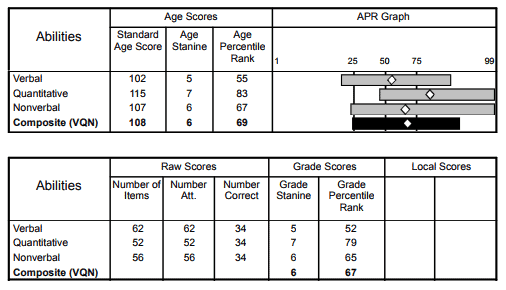
The number of questions your child answered correctly in each battery. Raw scores are converted into the scores below, so they are rarely used on their own.
A normalized score that compares your child with students of the same age. The average SAS is 100, and scores range from 50 to 160.
A simplified 1–9 scale. Stanines 1–3 are below average, 4–6 are average and 7–9 are above average.
Shows the percentage of same-age or same-grade students your child scored higher than. A percentile rank of 90 means your child scored higher than 90% of peers. Many GT programs look for scores at or above roughly the 90th–97th percentile.
A combined score across all three batteries (or selected batteries, depending on the district). Many gifted programs consider both the composite and individual battery scores.
Recognized Globally for Excellence

Applied Education

Standards Aligned

National Accrediation

Award Winner
CogAT Test Prep at Big Brainbox
Yes, but not by memorizing answers. The most effective CogAT test prep builds the verbal, quantitative and nonverbal reasoning skills the test measures, and removes the surprise factor so unfamiliar question types like paper folding and figure matrices don't cost your child points. At Big Brainbox, we focus on research-based CogAT preparation that develops skills your child keeps long after test day.
For many families, the CogAT is the gateway to GT services, advanced classes and enrichment opportunities. A strong score can open the door to a more challenging, engaging learning environment, while a lower-than-expected score can delay access by a year or more until the next screening window.
Gifted abilities often appear early, and the CogAT is frequently given in Kindergarten, 2nd or 3rd grade. With GT seats limited across Frisco and the wider DFW area, helping your child walk in familiar with the format and confident in their reasoning gives them a fair chance to show what they can do.


Parents play a big role in CogAT success, and the best results come when parents and instructors work as partners. Alongside structured prep, try these at home:
• Play pattern and logic games like tangrams, pattern blocks and chess to build nonverbal reasoning.
• Ask how things are alike and different ("How are a whale and a bat alike?") to build verbal reasoning.
• Make math playful with number puzzles and "what comes next" sequences.
• Practice listening to multi-step directions, especially for K–2 students.
• Use a few practice questions for familiarity, not hundreds.
• Keep it low-pressure: protect sleep and praise effort over results.
Every family's situation is different. Here's an honest look at the main CogAT preparation options, so you can choose what fits your child best.
Practice books and apps at home. Best for older, highly self-disciplined students. Low cost and flexible, but there's no one to explain why answers are wrong, and young children find it hard to stay motivated.
Easiest method for Parents
Not much preparation needed
Not much preparation needed
Most difficult for the student
Lots of discipline required
Should be very familiar with the approach
Some schools offer CogAT familiarization sessions. Convenient and familiar, but rarely available and usually not tailored to each child. If your school offers it, ask about instructor qualifications.
Easy commute for Parents
Familiar and Trusted Environment
Same approach as that of academics
Doesn't have any tailored coaching
Not offered by many schools
Highly personal and affordable, but it demands heavy planning and discipline from both parent and child, and it's hard to know whether practice matches your child's test level.
Best experience for Students
Tailored to the needs of the student
Worst experience for the Parents
Lots of planning & preparation
Heavy discipline needed from both student and parent
Expert instruction with diagnostics, mock tests, progress tracking and make-up sessions. Usually the most investment, but the most guided and measurable option. Online classes remove the commute.
Best experience for Students
Tailored to the needs of the student
Best experience for Parents
Well planned curriculum
Progress monitoring
Involves mock tests
Includes make-up sessions
Usually, an expensive option
Parents need to commute
Most CogAT prep options are a book or an app full of practice tests. Ours starts with a free readiness assessment, then combines guided practice, test-taking strategies and hands-on reasoning activities, led by educators who adjust every session to your child.
Students learn in various styles with some students leaning towards Visual with some Auditory and other methods.
At Big Brainbox, we identify the style of learning for your child that best helps them to prepare for the exam.
Depending on the style of learning for the student, teachers propose a test preparation path for the student with set goals for the each of the sections.
The plan is then discussed and reviewed with the parents to ensure everyone is on the same page.
Once Learning Style and CogAT Test Preparation Plan is set in place, teacher and the staff will provide ongoing guidance to the student and measures the progress regularly.
If needed, CogAT test preparation path will be amended as needed during the duration of the test preparation course.
We start with a baseline CogAT-style assessment, then use regular timed mock tests to track growth in each battery. Sessions focus on the question types where your child needs the most growth, with extra support added when needed.
Mock tests or assessment tests as someone may call them are essential to understand the strengths and areas of improvements of the students.
At Big Brainbox, our qualified teachers will conduct the initial assessment to establish baseline and regularly schedule mock exams for the students for continuous measurement.
With every mock exam, students improve on the areas which they were given to focus on. This makes steady progress on the each of the batteries for CogAT including Verbal, Quantitative and Non-Verbal.
If additional sessions are needed, the teachers work with the students to setup time for additional training session as needed.
The most common age for gifted screening. Questions are picture-based and read aloud, so prep focuses on careful listening, following multi-step directions, spotting patterns and building stamina, using short, game-like activities. Ideal for families looking for the best CogAT prep for 2nd grade.
Students now read questions on their own and work under tighter time limits. CogAT preparation for elementary students at this level strengthens vocabulary in context, number reasoning and multi-step nonverbal puzzles, along with pacing strategies.
Abstract analogies, complex number series and harder spatial reasoning. Prep focuses on efficient problem-solving and accuracy under time pressure, skills that also carry into later tests like the ISEE and PSAT.
Join CogAT prep classes at our campus at 4577 Ohio Dr, Suite 110, Frisco, TX 75035, convenient for Frisco, Plano, McKinney, Prosper and Little Elm families, or choose live online CogAT prep classes with the same coaches and curriculum.


Every student learns differently. Our CogAT coaches tailor pacing, practice and strategy to your child's strengths, gaps and test date.
Helping your student overcome test anxiety
Providing important subject-based knowledge
Teaching specific test-taking strategies

Individualized instruction and realistic practice help children walk in calm and confident.
Our tutors are trained to tailor sessions to the needs of both neurotypical and neurodivergent students, including students with ADHD and dyslexia.
Individualized pace and progression
Reinforce and review key concepts
Overcome learning obstacles
Additional Support for Gifted & Talented

We identify your child's strengths and goals, then build skills one question type at a time, from the basics to timed, test-level practice, so confidence grows alongside ability.
Puzzles, logic games, quizzes and challenge hunts turn pattern recognition and number reasoning into something kids look forward to.
Hands-on experiments and building challenges let students apply analogy, classification and spatial reasoning to real problems, which helps the skills stick.
Every lesson links a CogAT skill to everyday life, from spotting patterns in nature to solving number puzzles, so children understand why the thinking matters.
Educators with Texas ISD classroom experience who understand how local gifted and talented identification works.
We build reasoning ability that helps in class, not just on test day, with a real-world connection in every lesson.
Regular mock tests and clear progress reports show parents exactly how their child is improving in each battery.
A positive, encouraging environment with tutors trained to support gifted, neurotypical and neurodivergent learners, in person in Frisco or live online.
Comprehensive Coverage
Perfect for homework help and skill maintenance
$2454 sessions/month (1x weekly)
1-hour weekly sessions
Personalized curriculum
Progress reports
Email tutor access
Learning resources
10% Sibling Discount
5% Military & Veteran Discount
5% First Responder Discount
Ideal for building skills and closing gaps
$3454 sessions/month (1x weekly)
1-hour session once weekly
Customized learning plan
Weekly progress updates
Direct tutor messaging
Parent conferences
Practice materials
10% Sibling Discount
5% Military & Veteran Discount
5% First Responder Discount
All plans include a free initial assessment and satisfaction guarantee.
Need a custom plan? Contact us for corporate, school, or multi-student discounts.
It happens more often than parents think, and it rarely means a child isn't bright. Many districts allow referrals or retesting in later grades, so the right preparation now can make a real difference.
Unfamiliar question formats like paper folding and figure matrices, rushing or running out of time, trouble following oral directions in a group, one weaker battery pulling down the composite, or simply test anxiety on the day.
Book a free readiness assessment. We'll pinpoint which battery and question types cost the most points and build a focused plan to strengthen them before your district's next testing window.
Try these original CogAT-style practice questions with your child. Answers are at the end of each set.

1. Bird is to nest as bee is to ___? (a) flower (b) hive (c) honey (d) wing
2. Maya wore her heavy coat because it was very ___ outside. (a) sunny (b) cold (c) loud (d) bright
3. Apple, banana, grape. Which belongs with them? (a) carrot (b) cherry (c) bread (d) potato
4. 3, 6, 12, 24, ___? (a) 30 (b) 36 (c) 48 (d) 26
5. 2 → 6, 4 → 12, 5 → ___? (a) 10 (b) 15 (c) 20 (d) 9
Answers: 1-b (a bee lives in a hive), 2-b, 3-b (all fruits), 4-c (each number doubles), 5-b (multiply by 3)
1. A circle, an oval and a ring belong together. Which also belongs? (a) a square (b) a triangle (c) an egg shape (d) a star
2. Top row: a small circle becomes a large circle. Bottom row: a small square becomes ___? (a) a small square (b) a large circle (c) a large square (d) a small triangle
3. A square paper is folded in half and one hole is punched near the fold. When unfolded, how many holes are there? (a) 1 (b) 2 (c) 3 (d) 4
Answers: 1-c (only curved edges), 2-c (same shape, bigger), 3-b (the hole is mirrored)
Hear from families who chose Big Brainbox – and why they stayed.

4.9/5
It altered the attitude toward learning for my child– I no longer hear complaints about studying.
- Priya M.
Parent of a Level 6 student
“Who would think that I would ever have fun doing test preparation? Some people say that they like drawing or painting, I say that I enjoy building things and solving puzzles”
- Michael R.
Parent of a Level 5 student
“We noticed a big difference in how our daughter thinks through problems. She is more confident, enjoys solving puzzles, and feels much better prepared for the CogAT assessment.”
- James L.
Parent of a Level 5 student
“My son struggled with pattern recognition and problem-solving questions. With personalized guidance and regular practice, he has become more comfortable tackling challenging questions.”
- Fatima R.
Parent of a Level 8 student
The CogAT (Cognitive Abilities Test) is an aptitude test that measures verbal, quantitative and nonverbal reasoning. Schools use it mainly to identify students for gifted and talented programs and to guide placement and instruction.
Most students do well with 1 to 2 sessions per week over 8–12 weeks. If the test is less than 6 weeks away, 3 sessions per week (our Innovation level) is recommended.
We start with a free readiness assessment, then begin with the basics of each question type before building up to timed practice. New students settle in quickly because sessions feel like puzzles and games.
Testing dates are set by each school district, and many hold GT screening windows in the fall, winter or spring. Check your district's GT or advanced academics calendar, and start preparing 8–12 weeks before your child's window.
It measures reasoning and problem-solving skills, not school knowledge, across three batteries: Verbal, Quantitative and Nonverbal, with three subtests each.
The CogAT is available from Kindergarten through 12th grade. Many districts screen students in Kindergarten, 2nd or 3rd grade, and some test again in middle school.
The full test usually takes about 2 to 3 hours of testing time depending on the level. Schools typically split it across two or more sessions, especially for younger children.
A percentile rank of 50 or a Standard Age Score of 100 is average. GT cutoffs vary by district, but many programs look for scores at or above roughly the 90th to 97th percentile on the composite or one battery.
Yes. Children improve with skill-building and familiarity with the question formats. The most effective prep develops real reasoning skills instead of memorizing answers.
It's common and rarely means a child isn't bright. Unfamiliar formats, rushing or one weaker battery often pull scores down. Book a free assessment and we'll pinpoint which question types cost the most points and build a plan before the next testing window.
Yes. Our online CogAT prep classes are live and interactive, with the same coaches, curriculum and progress reports as our Frisco campus at 4577 Ohio Dr, Suite 110.
Small-group CogAT prep classes are $245/month and 1-on-1 CogAT tutoring is $345/month, with 10% sibling, 5% military and veteran, and 5% first responder discounts. Every plan includes a free initial assessment.