
Fall break camps only get a few days, so if you are worried about paying for days of filler, judge each one by what your child finishes and shows you at the end. Seven checks separate a camp that builds something real from one that only fills the time: a finished project, real building, planned mistakes, enough adults, a useful report, a link to this fall’s schoolwork, and dates that match your district.
You have seen the same words on every flyer for fall break camps: hands-on, STEM, fun, engaging. Those words do not tell you whether your child will spend Tuesday building a robot or watching someone else build one. The seven checks below do, and they work on fall break camps of any length, from a two-day workshop to a full five-day week.
Why can’t you pick fall break camps the way you pick summer camp?
You can’t, because fall break camps run for days, not weeks, and they land in the middle of your child’s school year instead of between grades. If you use your summer checklist on fall break camps, you end up paying for a schedule the break cannot hold.
A fall break camp is a short program of one to five days that runs while school is closed in October. Children go straight back to class afterward, so strong fall break camps connect to what students already study. They also finish every project before the last day, because no next week exists to pick it up.
A summer camp has eight to ten weeks to get things right, and a slow Monday costs you little. A two- or three-day camp has no slack at all. If the first morning goes to name games and a safety video, a third of what you paid for is gone before your child touches a tool.
October also works in your favor. By then, your child is about two months into a new grade. Their teacher has already started the year’s first science and math units, and your child has a fresh set of ideas to try out with their hands.
So the questions you ask about fall break camps need to fit a short break. The seven checks below are built for fall break camps, not summer ones.
What should your child actually bring home from a short camp?
Your child should bring home one finished project they built and can explain to you in their own words. That is Check 1, and it answers the first worry about any short camp: will anything actually get done?
A good short camp plans backward from one finished project. The child builds it, tests it, fixes what fails, and then explains how it works to an adult. The explanation shows what the child understood, and a parent can hear it in the car on the way home.
Picture what that looks like at your child’s age. A first grader builds a cardboard marble run that carries a marble from a tabletop to a cup on the floor. A fifth grader builds a small robot car that follows a black tape line. A seventh grader writes a simple game in a block-based coding tool, with a score counter that works.
You can test this before you pay. Ask fall break camps one direct question: what will my child bring home on the last day? The best fall break camps answer with a specific object and a specific skill, such as “a marble run with three turns, built by measuring and cutting ramps.” Fall break camps that answer with “lots of fun activities” have not planned the finish.
If you wonder whether building really beats watching, research on older students points the same way. A review of 225 studies of college science, technology, engineering, and math courses found that students in lecture-only classes were 1.5 times more likely to fail than students in classes built around active work (Freeman et al., 2014). That research studied undergraduates, not children, so read it as evidence about active work in general, not as a promise about any one camp.

Will your child build, or just be kept busy?
Your child should do the building and make the choices, not just stay in motion while an adult does the hard part. That difference is Check 2, and it is what you are really paying for.
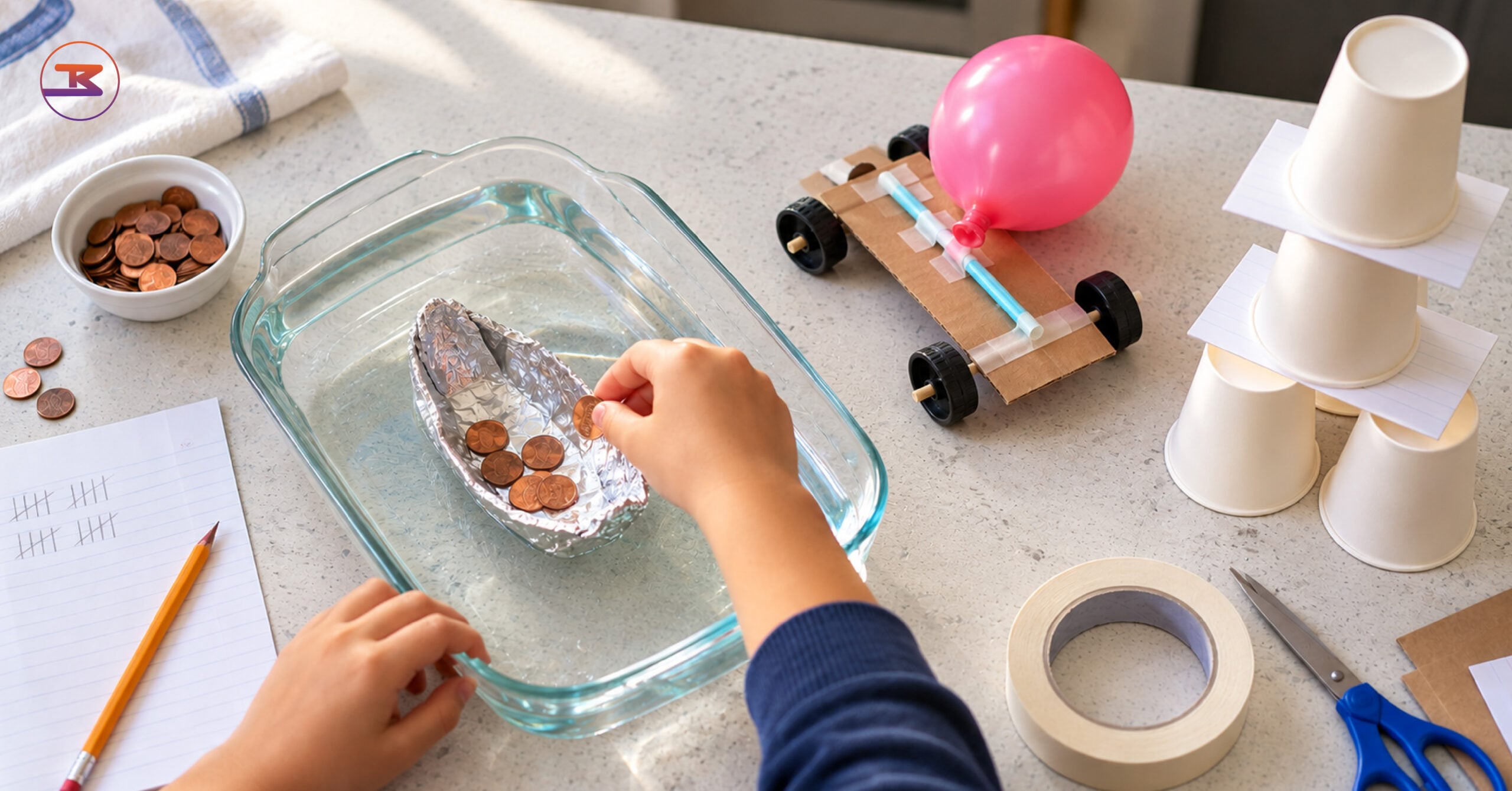
A hands-on activity puts the tools and the decisions with the child. The child picks a design, builds it, and sees what happens when it is tested. When an adult assembles the model and the child only decorates it, the activity is busy, not hands-on.
Nearly all fall break camps use the word hands-on, so ask two plain questions. What will your child hold in their hands during the first hour? How many minutes of each session go to a demonstration, and how many go to your child building? A camp that plans a 10-minute demo and a 50-minute build is running a workshop. A camp that plans a 45-minute demo is running a show.
When you compare fall break camps, ask to see a photo of a finished project from a past session. Look at the object, not the smiles. Crooked tape, uneven cuts, and a second attempt glued on top of the first all show a child did the work.
What if your child’s project fails?
That is good news, as long as your child gets to rebuild it. A failed first try costs your child nothing but a little time, and that is Check 3: good camps plan for projects to fail at least once.
Here is a simple version. A group builds a bridge from 20 popsicle sticks and glue, then loads it with pennies until it breaks. They count the pennies it held, rebuild it with the sticks arranged in triangles, and load it again. The first bridge breaking is the lesson, not the problem.
A camp is one of the few places your child can fail at a task with no grade and no report card attached. Fall break camps that schedule a second build after the first test give your child that chance on purpose. Ask the camp what happens when a project does not work. The answer you want to hear is “they fix it and test it again,” not “the teacher fixes it for them.”

How will you know what your child actually did all day?
You will know only if an adult was close enough to watch your child work, and that adult tells you what they saw. Those are Checks 4 and 5.
Check 4 is attention. Ask how many children each adult works with during building time, and whether that number changes in the afternoon. Ask who leads the project work: a trained teacher, a college student, or a volunteer. A room of 20 children with one adult at the front is a lecture with craft supplies. A table of six children with an adult sitting at it is a workshop.
Check 5 is the report. A useful end-of-camp report describes what the child did, not just that the child attended. It names what the child built, where the child got stuck, and what the child tried next. Two or three specific sentences from an adult who watched your child tell you more than a certificate or a single score.
Compare two versions you might hear at pickup. “Great week, a total star!” tells you nothing you can use. “Rebuilt the bridge three times and worked out alone that triangles held more weight” tells you how your child handles a problem that does not work the first time.
Most fall break camps hand out a certificate on the last day. Fewer fall break camps give each parent a short spoken or written account of their own child. Ask before you book which one you will get. If the answer is only a certificate, plan to ask the lead teacher two questions at pickup: what did my child build, and where did they get stuck?
If the report surprises you, keep it in proportion. A child who is shy on day one or rushes a build on day three is showing you one moment, not a pattern. Treat the report from fall break camps as one piece of a bigger picture you build across the school year: grades, teacher comments, and what your child chooses to do when no one assigns it.
Will the camp connect to what your child is learning in school this fall?
It should, and you can check in five minutes: the camp’s projects should use the same kinds of ideas your child meets in class, at your child’s grade level. That is Check 6.
Texas science standards for kindergarten through grade 8 include engineering practices, so designing, building, and testing a solution is part of what the state expects students to learn (Texas Education Agency, Science TEKS). A camp project that asks a child to design something, test it, and improve it practices that same skill. A camp that only runs experiments the child watches does not.
You do not need to read the standards to run this check. Look at your child’s class newsletter, the class website, or the last worksheet in their backpack. Find the science or math unit they are working on now. Then ask the camp one question: does any project this break use that idea?
Your kindergartner and a sixth grader need different work, so strong fall break camps split children into grade bands:
- Kindergarten to grade 2: short builds with large pieces, finished in under an hour, with lots of talking about what happened.
- Grades 3 to 5: projects that need measuring, a plan on paper, and at least one test and rebuild.
- Grades 6 to 8: a problem hard enough to argue about, where the group compares two designs and uses numbers to pick one.
Mixed-age fall break camps are not automatically bad, but ask how the camp adjusts the work. The project itself should stay the same for everyone in a band. What changes is the support around it: more hints for one child, a harder extra challenge for another. A camp that hands a younger child a simpler, different project has split the group without telling you.
If your child is working above or below grade level, say so when you register. Fall break camps that ask about your child before the first day are planning for your child, not just for a headcount.
What should you confirm before you pay?
Confirm that the camp’s dates match your child’s actual days off, then confirm the hours, food, and pickup plan. That is Check 7, and it comes before every other check, because a great camp on the wrong days is no help to you.
Texas school districts set their own calendars, and the number of October days off changes from one district to the next. Open your school’s calendar first. Then lay the camp’s dates next to it, day by day. A camp that starts the day after your child goes back to school solves nothing, and fall break camps built around a neighboring district’s calendar are an easy mismatch to miss.
Before you pay, get a clear answer to each of these:
- The exact dates, checked against your district’s calendar, not last year’s.
- Half day or full day, and the exact drop-off and pickup times for each.
- What one day looks like, hour by hour, including how much time goes to building.
- Whether lunch is provided, or whether your child brings one.
- Whether materials are included, or whether you buy a kit.
- Whether you may watch, and whether you need to ask ahead.
- What your child brings home: the project, a photo, or a report.
One more question sorts fall break camps quickly: is this a class or child care? Some programs are licensed child-care facilities, and some are classes that teach a skill for a set number of hours. Ask which one you are booking, so you know what the program is set up to do and what it is not.
Book early if you can, but not before the dates line up. A deposit on the wrong three days is the most expensive mistake on this list. Once the calendar checks out, fall break camps are easy to compare on the other six checks.

How does the Big Brainbox fall break camp in Frisco measure up?
The Big Brainbox fall break camp in Frisco is built on the same idea as this checklist: your child builds, tests, and finishes a real project instead of watching one. Frisco families have several fall break camps to choose from, so here is how this one lines up against the seven checks, based on what its camp page states.
- A finished project (Check 1): The camp page states that every camper leaves with a project they built themselves.
- Real building (Check 2): Projects cover robotics and engineering, coding and game design, and applied science experiments, with a play-based STEM track for younger children.
- Planned mistakes (Check 3): The page describes trial and error as part of the work, with students testing, rebuilding, and adapting their designs.
- Enough adults (Check 4): The page says projects are led by certified teachers. Ask how many children sit with each teacher during building time.
- A useful report (Check 5): Ask at registration what you will hear at pickup, and ask for the two things this post recommends: what your child built and where they got stuck.
- A school connection (Check 6): The page states the camp aligns with NGSS and CSTA, the national standards frameworks for science and for computer science.
- Dates that fit (Check 7): Check this year’s schedule, hours, and half-day or full-day options on the camp page against your district calendar before you commit to any of the fall break camps on your list.
Short fall break camps suit a particular kind of child especially well: the one who takes the TV remote apart, builds forts out of couch cushions, or asks how the dishwasher knows when to stop. A few days built around applied projects turns that curiosity into one finished thing they made. You can see this year’s projects, schedule, and grade groups on the Big Brainbox fall break camp page, and compare it with other fall break camps using the same seven checks.
Big Brainbox builds its camps around applied education: a child learns an idea by using it to build or solve something real, often inside a story or a game. The marble run, the tape-line robot car, and the popsicle-stick bridge in this post are the kind of projects that approach produces.
The camp pairs naturally with the Big Brainbox skill-based learning assessment. Camp shows you what your child does with their hands over a few days. The assessment page describes a look at where your child stands across three dimensions, visual, verbal, and written or hands-on work, ending with a written report and a conversation with you. Book it before camp to know what to watch for at pickup, or after camp to decide what comes next.

What can’t a short camp do for your child?
A short camp gives your child a sample, not a skill, so do not expect coding mastery by the end of the break. Two to five days is enough to finish one project and to find out whether your child wants more.
Children get good at building things the way they get good at piano: by coming back to it many times, weeks apart, with each round a little harder than the last. One break cannot supply that. Fall break camps that promise your child will “master coding” in a few days are promising something the calendar does not allow.
What a good short camp does give you is a first, real piece of competence to see. A child who rebuilds a bridge until it holds 200 pennies knows something true about triangles, and knows it because their own hands proved it. Big Brainbox’s view is that confidence comes after competence like that, not before it. A child earns confidence by doing a hard thing, not by hearing that they are good at it.
If a camp shows you a spark, your next move is repetition. Big Brainbox’s STEM enrichment programs are built for that, with projects that get harder level by level, so a child who liked one camp project keeps building from where they stopped.
And if the camp shows you no spark at all, that is useful too. A child who spent the break building a robot car and came home more interested in the story they made up about it is telling you something. Fall break camps are low-stakes experiments compared with a full semester of the wrong class.
The question to ask at pickup from any of the fall break camps you try is not “Was it fun?” It is “What did you build, and what would you change if you built it again?” If your child has an answer, the break was not wasted. What you do with that answer in the weeks after the break is the part no camp can decide for you.
Sources
- Freeman, S., Eddy, S. L., McDonough, M., Smith, M. K., Okoroafor, N., Jordt, H., & Wenderoth, M. P. (2014). Active learning increases student performance in science, engineering, and mathematics. Proceedings of the National Academy of Sciences, 111(23), 8410–8415. https://doi.org/10.1073/pnas.1319030111
- Texas Education Agency. Science (Science TEKS resources). https://tea.texas.gov/educators/subject-areas/science/science