
Fall break camps in Frisco only work if they cover the exact days your child’s school is closed and send your child home with something they built. This checklist gives you eight things to confirm before you pay: the calendar, licensing, grade groups, the finished project, building time, adults per child, logistics, and the pickup report.
Each item below has three parts: the question to ask, what a good answer sounds like, and the red flag that tells you to keep looking. Print it, keep it next to the flyers, and run every one of the fall break camps in Frisco on your list through the same eight items.
What Should a Fall Break Camp Checklist Cover?
A fall break camp checklist covers three things: whether the camp fits your days off, whether it is set up safely for your child, and whether your child will build something real. Eight items handle all three, and each one takes a phone call or a few minutes on a website.
A fall break camp is a short program that runs while school is closed for a few days in autumn. A useful checklist for one asks about dates, supervision, grade fit, daily building time, and what the child finishes. Each question gets a specific answer, such as a time, a number, or an object, rather than a promise.
Work through the items in order, because the first one can rule out fall break camps in Frisco before you spend time on the rest. Here are the eight at a glance:
- The Calendar: the camp runs on the days your child is actually off.
- Licensing: you know whether you are booking licensed child care or a class.
- Grade Groups: your child works with children close to their grade.
- The Finished Project: your child brings home one thing they built.
- Building Time: most of each session goes to building, not watching.
- Adults: an adult sits close enough to see your child’s work.
- Logistics: hours, lunch, materials, and refunds are clear before you pay.
- The Pickup Report: you hear what your child built and where they got stuck.
Use the list the same way for every option. When fall break camps in Frisco all describe themselves with the same words on a flyer, specific answers are the only fair way to compare them. For the reasoning behind each check in more depth, our guide to what to look for in fall break camps explains it step by step.

How Do You Match Fall Break Camps In Frisco to Frisco ISD’s Calendar?
Put the dates of fall break camps in Frisco next to Frisco ISD’s student calendar and check them one day at a time. Item 1 comes first because a great camp on the wrong days is no help to you.
School districts set their own calendars, and fall days off do not always form a neat Monday-to-Friday week. A district can close on a Friday and then again on the following Monday and Tuesday, with a weekend in between. A camp sold as a five-day week can leave a family paying for days the child spends in class.
Here is how the 2026–27 school year looks. The district lists no school for students on Friday, Oct. 9, and on Monday and Tuesday, Oct. 12–13, then a full Thanksgiving break from Nov. 23 to 27 (Frisco ISD, 2026–27 academic calendar). That makes the October break three weekdays split by a weekend, not a five-day week.
That split shapes how you compare fall break camps in Frisco. Ask three questions: Can I book only the days my child is off? Is the camp open on the Friday before the weekend? Does it close for the Monday holiday? Columbus Day falls on Monday, Oct. 12, and some camps close on public holidays, so a camp that skips that Monday covers only two of your three days.
Good answer: “Yes, you can book Friday, Monday, and Tuesday separately, and we are open all three days.” Red flag: a fixed block of dates that runs past Oct. 13, or a price that only comes as a full week. Fall break camps in Frisco that sell days your child spends in class are charging you for coverage you do not need.
Thanksgiving week is simpler on paper: five weekdays in a row. Ask which of those five days the camp actually runs, and whether it closes on Thanksgiving Day itself.
What If Your Child Attends a Different District or a Private School?
Use your own school’s calendar, not Frisco ISD’s. Frisco ISD says it weighs breaks that align with neighboring districts when it builds its calendar, but aligning is not the same as matching, and private schools set their own days. If your child’s days off differ, ask fall break camps in Frisco whether they sell single days.
Write your child’s actual days off at the top of this checklist, and hold all the fall break camps in Frisco you are considering to that list. A camp that fits a neighbor’s calendar and misses yours is the wrong camp for this break.

Is The Camp a Class or Licensed Child Care?
Ask the camp directly whether it is a state-licensed child-care operation or a class that teaches a skill for set hours. Both kinds of fall break camps in Frisco exist, and Item 2 tells you which rules the program you are booking follows.
In Texas, the state regulates licensed and registered child-care operations, inspects them against minimum standards, and posts inspection reports online for parents. A program that runs as a class rather than child care is not part of that system. Neither type is automatically better, but they are not the same product.
For a licensed camp, check the record yourself. The state’s Search Texas Child Care database lets you look up a regulated provider and review its inspection results, and Texas Health and Human Services suggests asking a provider to show its state permit and its last inspection (Texas HHS, Exploring Day Care). Reports on every inspection are available online (Texas HHS, Child Care), so a licensed provider’s history is a few clicks away.
For a class, ask different questions: who supervises during breaks and lunch, how drop-off and pickup are checked, and what the program’s written policies say. Good answer: a clear statement of what the program is, plus a copy of its policies. Red flag: fall break camps in Frisco that cannot tell you whether they are licensed, or that give a different answer when you ask a second time.
This item also tells you what to expect from the day. A licensed program is set up to supervise children; a class is set up to teach a skill in a set block of time. Pick the type that matches what you need this break, and compare fall break camps in Frisco within that type.
Does The Camp Group Children By Grade?
Good fall break camps in Frisco put your child with children close to their grade and adjust the support, not the project, for each child. Item 3 keeps your kindergartner away from a project built for a seventh grader, and the other way around.
A grade band keeps a project hard enough to matter and easy enough to finish. In a well-run band, every child works on the same project, and the adult changes the support: more hints for one child, an extra challenge for another. A camp that hands one child a different, simpler project has quietly split the group.
Here is roughly what each band looks like:
- Kindergarten to grade 2: builds a child finishes in one sitting, with big pieces and lots of talking about what happened.
- Grades 3 to 5: a plan on paper, real measuring, and at least one test before the build is done.
- Grades 6 to 8: two competing designs, and numbers from a test to choose between them.
Good answer: “We group K–2, 3–5, and 6–8, and here is the project for each.” Red flag: one project for ages 5 to 13 with no plan for the spread. When fall break camps in Frisco mix ages, ask how many children of each grade will be in the room.
Tell the camp about your child’s level when you register, whether they work ahead of their grade or need more time. Fall break camps in Frisco that ask about your child before the first day are planning for your child, not just for a headcount.
What Will Your Child Finish and Bring Home?
Your child brings home one finished thing they built and can explain in their own words. Item 4 is the simplest test of whether fall break camps in Frisco planned their days.
A finished project gives a parent proof that the camp days went to building. The child can show it, describe how it works, and explain what went wrong along the way. A stack of worksheets or a certificate shows attendance, not work.
Ask: what exactly will my child take home on the last day? Good answer: “A cardboard catapult that launches a pom-pom at least two meters, built and tuned by your child.” Red flag: “Lots of fun crafts and activities.” The first answer names an object and a skill; the second names neither.
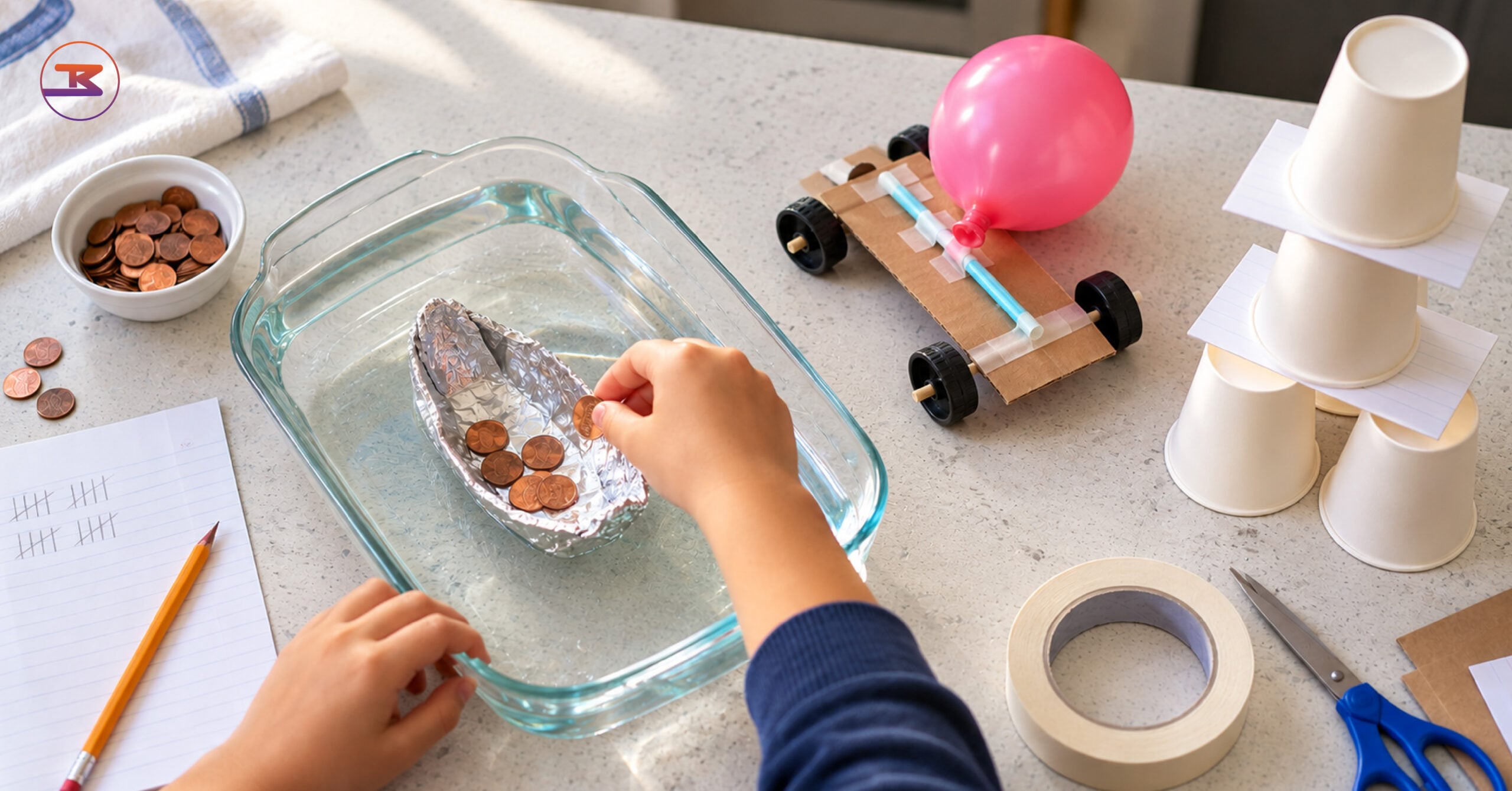
Picture it by age. A kindergartner brings home a paper-cup tower and tells you which cups went on the bottom and why. A fourth grader brings home a rubber-band car and tells you how far it rolled after the third change. An eighth grader shows you a simple game they coded and the bug that took an hour to find.
Ask this question of every one of the fall break camps in Frisco on your list, and write each answer down word for word. A camp that answers vaguely before you pay has not planned the finish.
How Much of Each Day Is Your Child Building?
In strong fall break camps in Frisco, your child spends most of each session building, not watching. Item 5 asks for that split in minutes.
Building time is when the child holds the tools and makes the choices. Demonstrations, instructions, and cleanup also take time, but they are not building. A camp that can tell you the minutes for each part of a session has planned it; a camp that cannot has not.
Ask: in a three-hour session, how many minutes go to building? Good answer: a number, such as “about two hours, after a 15-minute demonstration.” Red flag: a long demonstration and a short build, or no number at all. Fall break camps in Frisco that run a 45-minute talk before any child touches a tool are running a show.
What Happens When a Build Fails?
A failed first build is part of a good plan, as long as your child gets to rebuild it. Ask what happens when a project doesn’t work. Good answer: “They test it, change one thing, and test it again.” Red flag: “The teacher fixes it so everyone has one to take home.”
Here is what that looks like. A child builds a marble ramp from cardboard and tape, rolls a marble down it, and watches the marble fly off at the second turn. They tape a taller wall onto that turn, roll it again, and watch the marble reach the bottom. Fall break camps in Frisco that schedule that second test on purpose are teaching your child how to fix things.

Who Works With Your Child, and How Many Children Share Each Adult?
Ask fall break camps in Frisco how many children each adult works with during building time and who those adults are. Item 6 matters because an adult can only report what they were close enough to see.
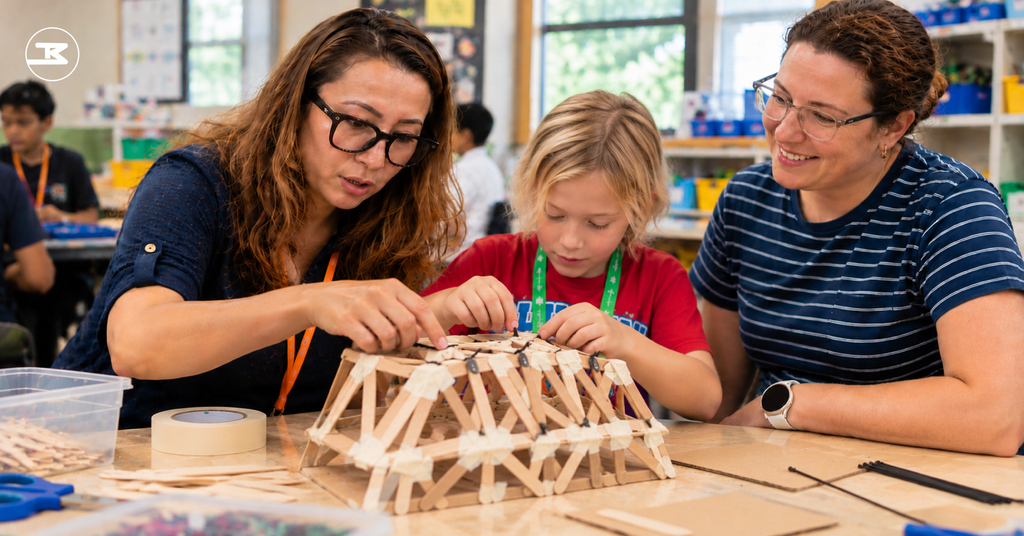
Count the adults at the worktable, not the ones on the brochure. At a worktable, one adult with six children can watch each child try, fail, and try again. An adult at the front of a room of 20 can watch only the room.
Ask: how many children work with each adult during building time, and does that change in the afternoon? Who leads the projects: a teacher, a college student, or a volunteer? Good answer: a number and a role. Red flag: “It depends,” with no number. When fall break camps in Frisco give you a ratio, ask whether it counts staff who are not in the room.
Write the answers from each of the fall break camps in Frisco side by side. The numbers are easier to compare than the adjectives, and a camp that hesitates on this one question has told you something.
What Do Hours, Lunch, Materials, and Refunds Look Like?
Get each logistics answer from fall break camps in Frisco in writing before you pay. Item 7 is where small surprises turn a good camp into a hard week.
A family needs five fixed facts before the first morning: drop-off and pickup times, lunch, materials, observation, and the refund rule. A camp can state each one in a single sentence. A fact left vague turns into a problem on day one.
- Drop-off and pickup times, and whether early or late options cost extra.
- Lunch: provided, or packed from home, and whether snacks are included.
- Materials: included in the price, or a kit you buy separately.
- Observation: whether you can watch, and whether you need to ask ahead.
- Refunds: what happens if your child is sick on day two, or the camp cancels.
Good answer: one clear sentence for each item, ideally on the camp’s own page. Red flag: a refund rule you only learn about after paying. Before booking any of the fall break camps in Frisco, check whether early drop-off covers the time you need to leave for work.
Fall break camps in Frisco that post these rules plainly are easier to plan around. If you have to call three times to learn whether lunch is included, expect the same on the first morning.
What Will You Hear at Pickup?
You should hear what your child built, where they got stuck, and what they tried next, from the adult who watched. Item 8 turns a few days of camp into something you can use.
A useful pickup report is two or three specific sentences from the adult who worked with the child. It names the project, the moment the child got stuck, and what the child did next. A report like that tells a parent how the child handles a hard problem, and “they had a great time” does not.
Ask before booking: will I get a short report on my own child, and from whom? Good answer: “The lead teacher gives every parent a few minutes at pickup on the last day.” Red flag: a certificate and nothing else. If fall break camps in Frisco offer only a certificate, plan to ask the lead teacher two questions yourself: what did my child build, and where did they get stuck?
Treat one report as one moment, not a verdict. A child who is shy on the first morning or rushes a build on the last afternoon is showing you a single day. Keep the reports from fall break camps in Frisco in the same place as teacher notes from school, and read them together.
How Does The Big Brainbox Fall Break Camp Fit This Checklist?
The Big Brainbox fall break camp is built around the second half of this checklist: your child builds one real project and takes it home. Here is how it lines up against the eight items, so you can hold it to the same standard as the other fall break camps in Frisco on your list.
The Big Brainbox fall break camp page states that every camper leaves with a project they built themselves. It also states that Big Brainbox is not a licensed child-care facility and provides skills-based instruction, which answers Item 2 directly. Everything else on this checklist, from hours to grade groups, is on the camp page for you to confirm.
- Calendar: Check the weeks listed on the camp page against Frisco ISD’s Oct. 9, 12, and 13 and Nov. 23–27, and ask whether the camp is open on Monday, Oct. 12.
- Licensing: The page states that Big Brainbox is not a licensed child-care facility. You are booking a class.
- Grade groups: Ask which grade group your child joins and what that group builds.
- Finished Project: The page states that every camper leaves with a project they built themselves.
- Building Time: Ask how many minutes of each session go to building.
- Adults: Ask how many children work with each adult during building time.
- Logistics: Ask for the hours, lunch, materials, and refund rule, and match each answer to the camp page.
- Pickup Report: Ask what you will hear on the last day.
The page also describes the camp as NGSS Aligned, meaning it states that its science work follows the Next Generation Science Standards framework.
Big Brainbox runs its camps on applied education: a child learns an idea by using it to build or solve something real, often inside a story or a game. Families comparing fall break camps in Frisco can see the current tracks, hours, and weeks on the Big Brainbox fall break camp page, then run it through Item 1 against their own calendar.
Not ready to commit to camp days? The skill-based learning assessment is the lighter first step. Its page explains what the assessment covers and what you receive afterward. Book it before camp to know what to watch for at pickup, or use it on its own to plan the rest of the school year.
What Should You Do Once The Break Is Over?
Ask your child what they built and what they would change, then decide whether that spark deserves a second round. Fall break camps in Frisco give your child a sample, not a skill.
Children build skill the way they learn to swim: by coming back many times, weeks apart, with each round a little harder. One break shows a parent whether the child wants that next round. At Big Brainbox, we hold that confidence comes after competence, so the next step after a good camp is more practice, not more praise.
If the spark is there, look for a weekly program that keeps the same kind of building going. If it isn’t, that answer is useful too, and it cost you only a few days. Either way, the checklist you used for fall break camps in Frisco works for winter and spring break as well: change the dates in Item 1 and keep the other seven.
The open question is yours, and no camp can answer it: what did your child keep building at home after the break, when no one asked them to?
Sources
- Frisco Independent School District. (2025, November 17). Board Approves 2026-27 Academic Calendar.
- Texas Health and Human Services. Exploring Day Care.
- Texas Health and Human Services. Child Care.