CogAT Prep: 7 Honest Answers to Ease Frisco Parents’ Worry
Reviewed By: Dr. Jill Hollander
14 minutes
Parent and teacher reviewing project work and a score summary, the full picture beyond CogAT prep
Before you buy a workbook or book a class, read what the research and your district actually say. This guide walks through the three CogAT batteries, how scores are reported, how Texas decides gifted placement, and the calm, everyday reasoning work worth doing at home.
Table of Contents
CogAT prep mostly changes how familiar a child is with the test, not how well that child reasons. Frisco ISD goes further and states on its gifted referral page that it does not support test preparation courses or materials, because they frequently skew results.
That leaves parents with a fair question: what kind of CogAT prep is worth doing, and what kind works against your child? This guide answers seven questions in order. It covers what the test measures, how scores are reported, what research says practice does, how Texas districts decide, what Frisco ISD says, what to do at home, and what one score cannot tell you.
Parent and child fitting tangram pieces at a kitchen table as low-pressure CogAT prep
What does the CogAT measure?
The CogAT measures reasoning in three separately scored sections, called batteries: verbal, quantitative, and nonverbal. Each battery holds three short tests, so a full CogAT has nine. Every test asks a child to find a rule in words, numbers, or shapes and then apply that rule to a new item.
Verbal battery: Picture Analogies, Sentence Completion, and Picture Classification.
Quantitative battery: Number Analogies, Number Puzzles, and Number Series.
Nonverbal battery: Figure Matrices, Paper Folding, and Figure Classification.
At that grade 2 level, two of the verbal tests use pictures instead of printed words. A seven-year-old sees a picture pair, such as a bird and a nest, and picks the picture that completes a second pair the same way. Older students meet the same reasoning in printed words and number problems.
Most CogAT prep targets these nine formats. A practice booklet copies the look of a figure matrix or a number series so the format feels familiar on test day. Whether that familiarity helps or hurts your child depends on what your district does with the score, which the sections below cover.
What does each format ask a child to do?
A number series shows a row such as 2, 4, 8, 16 and asks for the next number. A figure matrix shows a grid of shapes that change by a rule from left to right, with one cell missing. A paper-folding item shows a sheet folded and hole-punched, and the child picks how the holes look once the sheet opens.
Each of these formats has a trick that a child learns once and reuses. That learnable trick is exactly what CogAT prep sells, and it is also why a practiced score and an unpracticed score do not mean the same thing.
How is a CogAT score reported?
A CogAT report gives each battery and the composite three kinds of score: a Standard Age Score, a percentile rank, and a stanine. The Standard Age Score has an average of 100 and a standard deviation of 16. A percentile rank from 1 to 99 shows what share of same-age or same-grade students scored lower, and a stanine sorts the score into one of nine bands, with 5 as average.
Those definitions come from Riverside Insights’ own CogAT score descriptions. Age norms compare your child with a national sample of children the same age. Grade norms compare your child with children in the same grade.
On that scale, a Standard Age Score of 116 is one standard deviation above average, and 132 is two.
That scale explains why districts watch CogAT prep closely. When a few points decide which side of a cutoff a child lands on, a few points of practice gain matter to a placement committee. Read the next section before you count those points as a win.
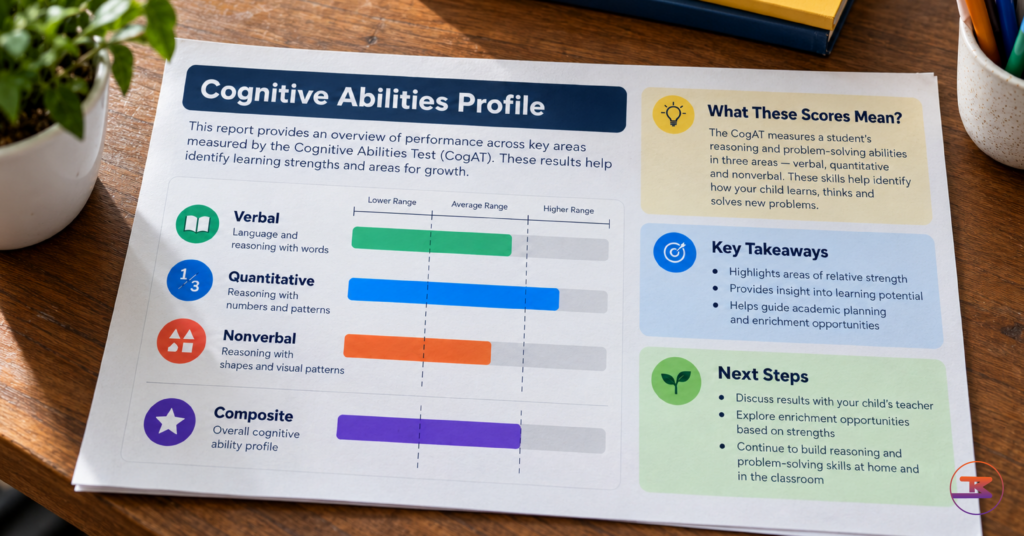
Ask your school for the report itself, not only the placement letter. The report shows all three battery scores, not only the composite, and that pattern tells you more than any CogAT prep result. A child with a high nonverbal score and an average verbal score has a different profile from a child with three even scores, even when the composites match. Ask the teacher what that pattern means for the classroom.
Sample-style CogAT report showing three battery bars and a composite bar, with no student name
Does CogAT prep raise scores?
Practice raises scores on cognitive ability tests, but only by a modest amount, and the gain grows when practice includes coaching or a repeat of the identical test. A 2007 meta-analysis pooled 50 studies covering more than 134,000 test-takers and found an average retest gain of about a quarter of a standard deviation.
That analysis, by Hausknecht and colleagues in the Journal of Applied Psychology, was framed around job and school applicants retesting, not young children. Treat the figure as a pattern, not a prediction for a CogAT score. The pattern is consistent in direction: scores rise on a second attempt, and they rise further with coaching.
The harder finding concerns what those extra points measure. A separate 2007 study of 941 candidates, by Lievens, Reeve, and Heggestad, found that retest scores leaned more on memory and less on general reasoning than first-attempt scores. Those retest scores also stopped predicting later performance.
What does CogAT prep not change?
None of the studies above shows CogAT prep raising a child’s underlying reasoning. They show score gains on a familiar test. A child who has memorized how figure matrices usually shift scores higher on figure matrices, and the score then says less about how that child reasons through something new.
That gap is the core of the district objection. When CogAT prep inflates a score, the committee reads a number that describes the practice instead of the child. Services matched to that number fit the child less well.
How do Texas districts decide who receives gifted services?
Texas does not let a single test decide gifted placement. The state plan requires districts to collect qualitative and quantitative data through three or more measures for students in grades 1–12. A committee of at least three educators trained in gifted education makes the final decision.
Those rules come from the Texas State Plan for the Education of Gifted/Talented Students, revised July 2026. The plan also makes every kindergarten student automatically eligible for consideration. It requires districts to offer gifted assessment at least once each school year, in a language the child understands or through a nonverbal test.
The plan sorts evidence into two kinds. Quantitative measures are numbers, such as test scores. Qualitative measures are observations, checklists, interviews, student products, and performances. A CogAT score is one quantitative measure among at least three.
Some North Texas districts say outright that CogAT prep is unwanted. Richardson ISD’s CogAT page tells families that their child needs no preparation and warns that prep materials can invalidate the results. Richardson universally tests 2nd graders and uses CogAT results for gifted qualification.
For CogAT prep, the state rules change the math. A score inflated by CogAT prep still sits beside a teacher observation, a parent input, and a work sample. When those measures disagree, the committee sees the mismatch.
What does Frisco ISD say about CogAT prep?
Frisco ISD’s gifted referral page states that the district does not support test preparation courses or materials, because they frequently skew results and make appropriate placement harder to determine. The same page reports that practicing for ability and achievement tests has produced test anxiety on test day in some students.
The full statement sits on Frisco ISD’s Referral and Screening page. The district lists the tools it draws on: ability tests, achievement tests, planned grade-level products in elementary school, grades in secondary school, and observation inventories completed by teachers and parents.
Frisco ISD does not name its abilities test or its form. The district states that sharing form numbers or levels would weaken test integrity, and it notes that its abilities and achievement assessments change from year to year. A Frisco ISD family cannot confirm from the district that the CogAT is the test their child will take, so CogAT prep for that family rests on a guess.
Three more details on that page matter to parents. Parents, teachers, counselors, community members, and peers can all refer a student during each grade’s referral window. The district encourages parents to review prior testing data and talk with the classroom teacher before referring. Frisco ISD also does not use assessments from outside the school, such as a private clinician’s, for gifted placement decisions.
What does Frisco ISD ask parents to tell their child?
The district asks parents to tell children that the test gives the school information about how to meet their learning needs. That sentence turns test day from a verdict into a fact-finding visit. A child who hears “this helps your teachers plan for you” walks in with a different job than a child who hears “you have to get in.”
What if your child is not in Frisco ISD?
Other public districts, private schools, and charter schools each set their own policy on CogAT prep. Find your school’s gifted referral page and read three things: which tests it names, whether it comments on test preparation, and when its referral window opens. A school that says nothing about CogAT prep has not endorsed it. Ask the campus gifted teacher directly before you buy anything.
What CogAT prep makes sense at home?
The CogAT prep that fits Frisco ISD’s guidance looks nothing like test prep. It is everyday reasoning work, a calm explanation of what the test is for, and a full night of sleep. It skips practice booklets, timed drills, and question banks built to copy the nine CogAT formats.
This kind of CogAT prep builds nothing that a committee would read as noise. A child who builds, sorts, measures, and explains every week brings that habit to every measure in the file, including the teacher observation and the work sample.
What reasoning work fits each grade band?
Keep sessions to 15–20 minutes, two or three times a week, and fold them into things your family already does.
Kindergarten to grade 2: fill a tangram outline with all seven pieces, then design an outline for a parent to solve.
Kindergarten to grade 2: dump a jar of buttons on the table, sort them by one rule, and ask your child to guess your hidden rule from your piles.
Grades 3–5: double a cookie recipe that calls for 3/4 cup of sugar, and let your child work out the new amounts before measuring.
Grades 3–5: build a LEGO model from a single photo of the finished build, with no step-by-step booklet.
Grades 6–8: build a popsicle-stick bridge, load it with coins until it fails, and redesign the weak joint for a second test.
All grades: at the grocery store, pick four items and ask “which one doesn’t belong, and why?” Accept any answer your child can defend.
None of these activities is CogAT prep in the booklet sense, and none copies a CogAT item. That choice is deliberate. Each one asks a child to find a rule, test it, and explain it out loud, with a parent listening instead of grading.
Child loading coins onto a popsicle-stick bridge between two stacks of books while a parent watches
What should the night before look like?
Keep the evening ordinary: a normal dinner, no last-minute CogAT prep, and an early bedtime. The American Academy of Sleep Medicine consensus statement recommends 9 to 12 hours of sleep for children ages 6 to 12. Skip phrases like “everyone else is preparing” or “this decides your future.” Repeat the district’s line instead: the test helps the school plan for you.
When does a structured CogAT prep program make sense?
A structured program fits a narrower group than most CogAT prep marketing suggests. It fits a family whose school or program does not restrict test preparation, or a child who wants guided reasoning practice beyond the test itself. If your child attends Frisco ISD, read the district statement above before enrolling in any CogAT prep program, including ours.
Big Brainbox runs a CogAT prep program at its Frisco campus. As of 21-Oct-2026, the program page lists small-group (5:1) and one-on-one (1:1) formats, an initial mock test to set a baseline, and work across the verbal, quantitative, and nonverbal batteries. The program does not change how a district committee weighs your child’s file, and no program promises a placement.
Judge any CogAT prep program, ours included, on three checks. It starts with a baseline before it teaches anything. It works on reasoning a child uses outside the test, not only the nine formats. It never promises a score or a seat in a gifted program. A program that fails the third check is selling a result nobody controls.
Families not ready to commit to a program start with one meeting instead. The Big Brainbox skill-based learning assessment includes a CogAT option under test prep. As of 21-Oct-2026, its page lists 45–60 minutes per subject, a written report within 48 hours, a parent consultation, no pass or fail result, and a cost of $0. Frisco ISD does not use outside assessments for placement, so that report is for your family’s planning, not the district’s file.
What can one CogAT score not tell you?
A CogAT score cannot show how a child works when a project breaks, how they explain an idea to a group, or what they return to without being asked. Texas already accounts for that gap by requiring at least three measures, with observations and work samples alongside the test.
Big Brainbox builds on the same principle: one marker cannot tell you whether a child absorbed an idea, can carry it, and can use it under pressure. A single figure summarizes one morning. A file of observations, projects, and scores describes a child.
So weigh CogAT prep against everything else a child does in the weeks before testing. Twenty hours of CogAT prep is twenty hours not spent on the reading, building, and talking that every other measure in the file records.
Some questions stay open, and we say so. Nobody has established how well an early profile, ours included, predicts where a child lands years later. Your child’s CogAT score, with or without CogAT prep, answers one question on one day. The questions that matter more, such as what they will build and what they will choose, are still being answered.
Parent and child fitting tangram pieces at a kitchen table as low-pressure CogAT prep
No. The CogAT measures learned reasoning skills and cognitive abilities related to academic learning. It is not an IQ test.
Can Students Improve Their CogAT Scores?
Students can improve performance by strengthening reasoning skills, becoming familiar with question formats, and building confidence through structured practice.
How Early Should We Start Preparing?
Most students benefit from beginning preparation 4 to 8 weeks before testing.
How Much Should My Child Practice?
Quality matters more than quantity. Short, consistent sessions are generally more effective than long study marathons.
About Big Brainbox
Big Brainbox is a readiness education center in Frisco, Texas, working with students from K through 12th grade. Our instructors and curriculum team write these posts from what happens in the room: what a child builds, where a child stalls, and what changes when the work is real. We publish what we observe and cite what we borrow.