
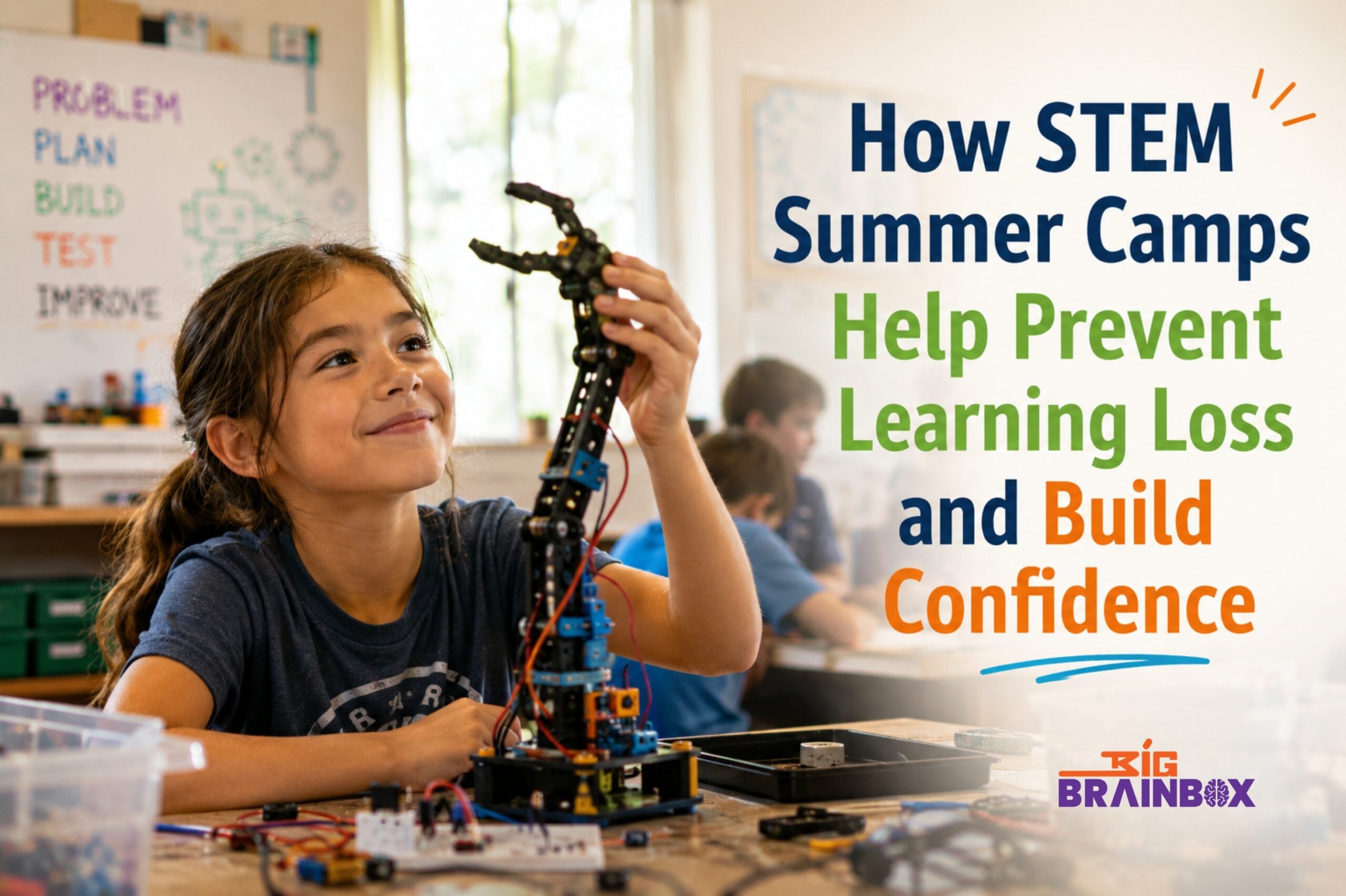
How STEM Summer Camps Help Prevent Learning Loss
Every June, something happens quietly in millions of households across America. School lets out, backpacks disappear under beds, and the long, unstructured days of summer begin. For most parents, the hope is simple: their child rests, recharges, and comes back to school in August ready to go.
What actually happens is more complicated and more costly than most families realise.
Research consistently shows that children can lose two to three months of academic progress over a typical summer break. For kids in math, the loss is especially sharp. For children who were already behind, summer can widen the gap significantly. This is what researchers call the summer slide and it’s one of the most well-documented, preventable problems in K–12 education.
The good news: the right summer experience doesn’t just stop the slide. It reverses it. And for a growing number of Frisco-area families, STEM summer camps have become the most effective way to do exactly that while building something academic programs rarely measure: genuine confidence.
This post walks through what the research says, what makes a STEM camp effective versus one that’s just fun, and what parents should look for when choosing a program for their child this summer.
What Is the Summer Slide and Why Does It Matter?
The term “summer slide” was first documented in the 1990s by researchers Karl Alexander, Doris Entwisle, and Linda Olson, whose landmark Baltimore study tracked children from first grade into adulthood. Their data showed that the gap between higher- and lower-income children in reading, math, and long-term outcomes wasn’t primarily shaped by what happened during the school year. It was shaped by what happened during summers.
Children from resource-rich environments engaged in structured learning, enrichment activities, and intellectually stimulating experiences over the break. Children from less resourced environments largely did not. By high school, those compounding summer gaps had become the defining driver of the achievement gap.
Since that study, the findings have been replicated across dozens of contexts:
- Students lose an average of 2.1 months of math skills over summer, according to a meta-analysis published in American Educational Research Journal
- Reading skills decline at roughly one month per summer on average, with greater losses in comprehension than in foundational decoding
- The effects are cumulative by fifth grade, the summer slide accounts for approximately two thirds of the reading achievement gap between income groups
- Low income students lose ground in both math and reading; middle and upper-income students often make slight gains, primarily through enrichment activities
Here’s the important reframe for Frisco families: summer slide isn’t just an issue for children falling behind. Even high-performing kids can stall or regress in specific skill areas particularly math fluency, logical reasoning, and scientific inquiry when those muscles go unused for 10 weeks.
The solution isn’t more worksheets. It’s applied engagement.
Why STEM Specifically? The Learning Science Behind It
Not all summer activities prevent the slide equally. Reading programs help with literacy. Sports camps build physical coordination and teamwork. What makes STEM programs particularly applied, project-based STEM programs unusually effective at addressing learning loss?
1. STEM Uses Math and Reasoning Every Day Invisibly
The subject that declines fastest over summer is math. This is partly because math, more than reading, requires regular practice to maintain fluency. When a child spends ten weeks without encountering mathematical reasoning in a meaningful context, the skills don’t disappear but they dull noticeably.
STEM activities embed math constantly, without the worksheet friction that causes resistance. A child building a circuit calculates resistance. A child designing a bridge applies principles of weight distribution and ratio. A child coding a game works through conditional logic and variables. The math is there, it just doesn’t feel like homework.
This “stealth learning” effect is why research on project based STEM education consistently shows stronger retention than traditional summer academic programmes. When math has a purpose the child cares about, they engage with it more deeply and retain it more durably.
2. Project-Based Learning Develops Working Memory and Executive Function
Executive function, the cluster of cognitive skills that includes planning, working memory, attention shifting, and impulse control is a stronger predictor of academic success than IQ. It’s also highly trainable in childhood.
Hands-on STEM projects are, at their core, sustained problem-solving tasks. A child building a robot must hold a goal in mind across multiple sessions, break it into sub-tasks, adapt when something doesn’t work, and persist through failure. Every one of those actions is an executive function workout.
Summer is one of the only times during the year when children have the space to work on something complex over multiple days without the pressure of grades or timed tests. For many children, STEM camp is the first time they’ve experienced that kind of sustained intellectual engagement and the effect on attention and self-regulation is measurable.
3. Applied Science Keeps Scientific Curiosity Alive
One of the less-discussed casualties of a passive summer is scientific curiosity. Children are natural scientists who observe, hypothesise, and test from the moment they’re mobile. School science can sometimes channel that curiosity into narrow, test aligned activities. Summer is when curiosity can breathe.
STEM camps that use real lab setups, genuine materials, and open-ended challenges rather than pre-packaged kits with predetermined outcomes maintain and amplify this natural drive to discover. When a child runs a chemistry experiment they designed themselves, they’re not just retaining science content. They’re reinforcing the identity: I am someone who figures things out.
That identity, what researchers sometimes call science self concept, is one of the most powerful predictors of whether a child will pursue STEM pathways later in life. And it’s built in exactly these kinds of ungraded, exploratory contexts.
The Confidence Problem and Why STEM Camps Address It Uniquely
Learning loss gets most of the attention in the research literature. But parents who bring their children to STEM programs often describe a different change as the most meaningful one and it has nothing to do with test scores.
They describe the child who always said “I’m not a math person” suddenly choosing to spend their evenings designing a new circuit. The child who hung back in groups leading their team’s robotics build by week two. The child who came home on the first day and corrected a parent’s understanding of how electricity works.
What’s happening in these moments isn’t just skill acquisition. It’s the construction of a new self-narrative.
Why Confidence Collapses Over Summer
School, for many children, is a place where they are measured constantly. Grades, standardized tests, reading levels, teacher feedback the assessment apparatus is relentless. For children who struggle in any subject, each assessment is another data point reinforcing the story: I am not good at this.
Summer removes the assessment pressure but for many children, it doesn’t replace it with anything constructive. They have more free time but fewer opportunities to experience genuine competence. They entertain themselves but don’t build anything. By August, the child who was fragile about math in June is even more certain they’re not a math person simply because they haven’t had a single experience to challenge that belief.
STEM camps designed around project completion change this dynamic fundamentally. The measure isn’t “did you get the right answer?” it’s “did you build something real?” And building something real is available to every child in the room, regardless of their academic history.
The Role of the Instructor Relationship
Research on confidence development in children is consistent on one point: the relationship with a trusted, skilled adult matters enormously. Children build self-belief partly through the mechanism of borrowed belief they begin to believe in themselves because someone credible believes in them first.
In a classroom of 25 students, the window for this kind of individual encouragement is narrow. In a programme with a 6:1 student-to-instructor ratio, an instructor can notice the specific way a child approaches a problem, name a genuine strength they’ve observed, and calibrate the challenge level to sit just above the child’s current ability the zone of proximal development where confidence and competence grow together.
This is why the ratio isn’t just a logistical convenience. It’s a pedagogical prerequisite for the kind of confidence-building that actually transfers out of the camp environment.
What the Research Says About Summer STEM Programmes
The evidence base for STEM summer programming has grown substantially in the last decade. Key findings:
Programme quality matters more than duration. A two-week, well-structured STEM programme with qualified instructors and authentic projects produces stronger outcomes than a six-week programme with passive content delivery. The mechanism appears to be engagement depth in how intensely children think during each session rather than the number of hours accumulated.
STEM summer programmes narrow the confidence gap as well as the skills gap. A 2019 study from the University of Houston examining summer STEM camps for underrepresented students found that participants showed significant gains not just in STEM content knowledge but in STEM identity and self-efficacy and that these confidence gains persisted into the following school year.
Parental engagement amplifies outcomes. Children who discussed their camp projects with parents at home explaining what they built, why it worked, what they’d change showed stronger skill retention than children who experienced camp as a standalone activity. This is why programmes that send home project documentation and Readiness Profiles create materially better outcomes than programmes that simply return children to their parents at 4 pm with a t-shirt.
Neurodivergent learners benefit disproportionately. Children with ADHD, ASD, and dyslexia who often experience school as a series of difficult social and academic demands frequently thrive in well-designed STEM environments. The structured, project-focused format reduces social ambiguity. The hands-on modality bypasses text-heavy instruction. The visible, tangible nature of project completion provides the clear feedback loop that many neurodivergent learners find motivating. Multiple studies on STEM camps for learners with learning differences report not just academic gains but dramatic improvements in self-reported confidence and school attitude.
What to Look For in a STEM Summer Camp: A Parent’s Checklist
Not all STEM camps prevent the slide. Some are essentially glorified daycare with a robotics kit on a table. Here’s what the research and practitioner experience suggest actually matters:
Project completion not activity participation
The goal of each week should be a finished thing: a robot that navigates a course, a working game, a documented experiment. Activities without endpoints don’t produce the “I built that” moment that builds confidence. Ask camps directly: “What does my child take home or demonstrate at the end of each week?”
A clear assessment at the start
A reputable STEM programme doesn’t assume every child is at the same level. Before your child’s first session, they should be assessed for prior knowledge, learning style, and challenge level so they start in the right place, not the default place. This prevents the two most common failure modes: a child who’s bored because the work is too easy, and a child who’s overwhelmed because it’s too hard.
A documented record at the end
Ask: what does the programme produce that proves what my child actually learned? A participation certificate doesn’t answer this question. A documented competency profile mapping specific skills demonstrated across specific projects does. This isn’t just better for your child’s confidence; it’s genuinely useful for school placement, gifted programme applications, and portfolio building for older students.
A small group size with qualified instructors
Anything above 8:1 makes individualised feedback unlikely. Look for 6:1 or lower. Ask about instructor qualifications specifically whether they have backgrounds in education or child development, not just STEM expertise. The best STEM instructor for a 7-year-old is not necessarily the person with the most technical knowledge.
Genuine curriculum alignment not just brand language
Terms like “NGSS-aligned” and “CSTA standards” mean something specific and verifiable. Ask camps which specific standards their curriculum targets and how they measure attainment. Vague claims like “we follow best practices in STEM education” should prompt follow-up questions.
Neurodiversity support that’s built in, not bolted on
If your child has ADHD, ASD, dyslexia, or any learning difference, ask how the programme has been specifically designed to serve them not just accommodated. A programme that offers neurodiversity support as an afterthought is very different from one where sensory considerations, executive function scaffolding, and flexible pacing are built into the curriculum design.
How Big Brainbox Summer Camp Approaches Learning Loss Prevention
At Big Brainbox, every element of the summer programme has been designed with the research above in mind.
Every child begins with a Competence Assessment, a structured evaluation of where they are across key STEM disciplines before their first session. This isn’t a test. It’s a diagnostic tool that helps instructors calibrate the challenge level, identify areas where a child has drifted over the school year, and set a meaningful baseline.
Across the summer, children complete one real, documented project per week across 12 disciplines from robotics engineering to chemistry lab design to AI app building. Each project is a complete learning arc: a Discovery phase where children understand the concept, and a Maker phase where they apply it.
At the end of the programme, every child receives a Readiness Profile, a documented map of every competency demonstrated, every project completed, and a clear indication of what they’re ready to tackle next. This isn’t a certificate. It’s evidence.
For families of neurodivergent learners, the Neuro Academy track offers sessions specifically structured for children with ADHD, ASD, dyslexia, and twice-exceptional profiles with sensory-aware environments, executive function support built into each session, and instructors trained in neurodivergent pedagogy.
And the student-to-instructor ratio is capped at 6:1 non-negotiable because the research is clear that the relationship between an instructor and a child is the mechanism through which both skill and confidence are built.
Talking to Your Child About Summer Learning (Without Them Rolling Their Eyes)
One of the most common concerns parents share: “My child doesn’t want to do anything educational in summer. How do I get them interested?”
A few approaches that work:
Lead with the project, not the subject. Don’t say “you’re going to learn robotics.” Say “you’re going to build a robot that navigates an obstacle course.” The outcome is the hook, the subject is the means.
Let them experience it first. Most reputable STEM programmes offer a free trial session. A child who experiences one genuine hands-on session who builds something, who solves something, who gets to the end of a day with something to show will form their own opinion. And in our experience, it’s usually a positive one.
Reframe “learning” as “making.” For many children, especially those who’ve had difficult experiences in academic settings, the word “learning” has become associated with sitting still, getting things wrong, and being evaluated. Introduce the summer experience as “making camp” or “building camp.” It’s not a rebrand, it’s an accurate description of what actually happens.
Connect it to what they already care about. A child obsessed with Minecraft can be introduced to Python programming through Minecraft automation. A child who loves baking can be introduced to chemistry through the science of how food transforms under heat. The curiosity is already there. Good STEM education meets it where it lives.
Summary: What STEM Summer Camps Actually Do
The summer slide is real, it’s measurable, and it compounds across years. But it’s not inevitable. The research is clear that structured, applied, project-based STEM learning over summer:
- Maintains and often strengthens mathematical reasoning and scientific inquiry skills
- Builds executive function and working memory through sustained problem-solving
- Develops STEM identity and science self-concept that persist into the school year
- Produces measurable confidence gains, especially for children who’ve struggled academically
- Has disproportionately strong effects on neurodivergent learners when the programme is properly designed
The conditions that make a STEM camp effective are specific: small groups, qualified instructors, project completion (not just participation), documented outcomes, and genuine curriculum alignment.
A summer spent on a screen passes. A summer spent building, designing, and discovering leaves something behind in skills your child can demonstrate, in confidence they carry into September, and in a self-belief that no worksheet ever built.
Ready to Reserve Your Child’s Spot?
Big Brainbox Summer Camp 2026 runs May 25 through August 14 in Frisco, TX. Half-day sessions from $345/week. Full-day immersion from $545/week. Grades K–8, 6:1 ratio, Competence Assessment and Readiness Profile included for every child.
Not sure yet? Book a free trial session with real projects, expert instructors, zero obligation.
Related Big Brainbox Programs
About Big Brainbox
Big Brainbox is the best STEM educational center in Frisco, TX, and provides preschoolers to middle schoolers with hands-on Summer break camps 2026, along with coding, robotics, and science classes. We help people become curious, solidify the knowledge at school, and develop skills that would be useful in the future in an enjoyable, safe atmosphere.
Frisco Campus & HQ
4577 Ohio Dr, Suite 110
Frisco, TX 75072